There is a lot of noise around Nick Robinson and Alex Salmond, culminating in cries of bias and wanting Nick sacked. We all know what video we are talking about here and we all know what actually happened, not in the BBC version but in the main version that the Yes campaign are posting. There is no getting away from it; it is there in front of our eyes. So what did happen?
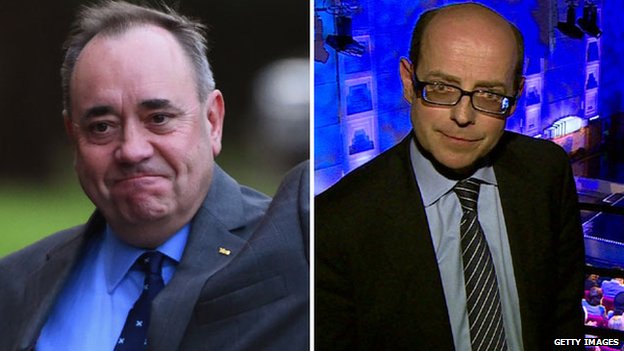
Well a journalist Nick asked Alex Salmond two questions. The first one asked if Alex Salmond believed that the moving of a head office had no consequences and that it would impact tax revenues. The second asked why voters should believe Alex Salmond over leaders of multinational companies. These are typical journalist type questions.
The response was not typical of a politician in its delivery but consistent with a politician in terms of its content. There was NO response to the second question at all, it was ignored. The response to the first question addressed some of it and misled in other parts of it. I am not going to assume that Alex Salmond knew the answer and lied I am going to assume he didn’t or hasn’t bothered to look it up.
Anyway here are statements about how corporation tax is actually allocated currently.
There is currently a difference between HMRC and GERS figures, SPICe explanation of the two are below and a brief explanation of what that means is that GERS takes the employment of people and allocates tax accordingly, HMRC takes where the profit are made and allocates it that way. The important thing to note is where it is unknown it is allocated to the registered Head office. So a HO moving does affect tax revenue.
“Scottish onshore corporation tax revenues are estimated as £2,976 million in GERS, but as £2,538 million by HMRC (a difference of £438 million). The difference is explained largely by the different methodologies used by HMRC and GERS to allocate tax receipts. Both GERS and HMRC allocate Scottish corporation tax revenue based on estimates of the location of profits. However, GERS uses regional accounts data published by the ONS whereas HMRC have used corporation tax paid by enterprises and measured how the activities of those enterprises are distributed across sub-UK areas. Where no information is available, HMRC have allocated tax receipts to the location of the headquarters. As a result, HMRC estimates that Scottish receipts as a share of UK are lower than the share shown in GERS (the HMRC estimate is 7.7% compared with a GERS estimate of 9.0% in 2011-12).”
Source:- http://www.scottish.parliament.uk/ResearchBriefingsAndFactsheets/SB_13-63.pdf
Of course the above is essentially a paper exercise and how it is allocated to show how the individual nations contribute to the UK, it has very little bearing on what happens with tax for companies that are either registered in our out of a country. So what does HMRC say about such a company under current legislation. Well the detail can be found at http://www.hmrc.gov.uk/ct/getting-started/intro.htm#1
The important points from this are as follows and copied directly from that document.
“If your company or organisation is based in the UK, you’ll have to pay Corporation Tax on all your taxable profits – wherever in the world those profits come from .
If your company isn’t based in the UK but operates in the UK – for example through an office or branch (known to HMRC as a ‘permanent establishment’) – you’ll only have to pay Corporation Tax on any taxable profits arising from your UK activities.”
So as we can see it is clearly very important where you base your company as the first quote strongly suggests that tax revenues regardless of where they are made will be due to the government where your registered office is. In this case the UK if the banks move registered offices. I’d strongly suggest that this is a concern for all of us.
Even if they don’t move office the majority of the tax would still fall to the UK by the second statement as they would not be taxed on estimates but by actuals and given that 90% of the financial sector business is done in the rest of the UK, well you get the picture. Best case scenario is we have nearly all the tax GERS thinks we are due but not quite by at least £400 million.
All this isn’t great news and shows Alex Salmonds lack of understanding of the issues that the banks raise. It is also concerning that yet again when asked a question he does not like he turned aggressive and belligerent. I am not sure that it is appropriate for a politician to behave that way let alone the First Minister of Scotland.
Finally the bad news for poor old Nick is that I can’t answer his second question either although I hope I have a done a better job than Alex Salmond on answering his first. Yes a Head Office move does have consequences, one of which is a reduction of tax revenues to the Scottish treasury.






 kenlaidlaw
Leave a comment