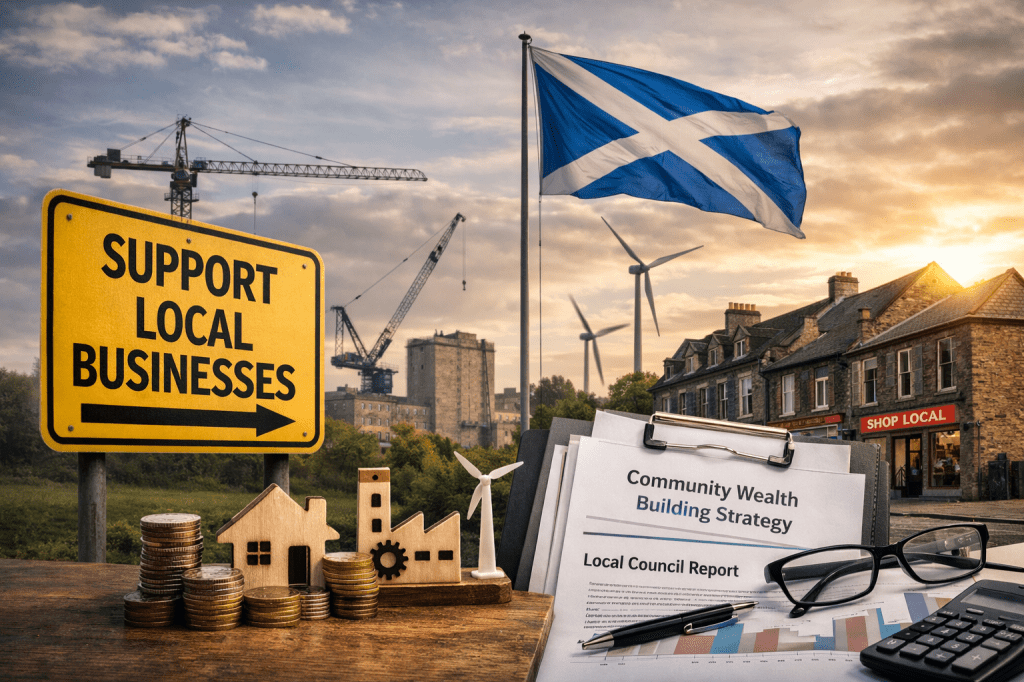
A Good Idea – But one the SNP may fail to deliver
The new Community Wealth Building (Scotland) Bill has recently passed through the Scottish Parliament, and it has done so with remarkably little fanfare. Which is a shame, as I think it is, in principle, a genuinely good idea from this SNP government.
We spend billions every year in our councils and public bodies. What this bill aims to do is to get more of that money to be spent locally. Essentially, using that spending power to support local businesses, keeping wealth circulating in the local economy and, over time, reduce long-term economic inequality.
I’m not saying this won’t happen, and I genuinely hope it does. But there are several hurdles to overcome, not least of all the SNP’s record on delivery. Their track record of turning well intentioned frameworks into effective working systems is, I think it’s fair to say, not great.
What the policy is trying to do isn’t radical. It puts a framework in place where councils will be required to create a plan of action that aims to:
- Spend more money with local firms
- Support Co-ops and employee-owned businesses
- Encourage community ownership of assets
- Regenerate derelict land
- Track how much public spending actually stays local
This kind of policy isn’t new. Variants of it have been used by Labour Councils South of the border (the Preston Model), by cities in the US, and similar models can be found across Europe, such as in Spain with the Mondragon Co-ops. So, this isn’t new or some radical economic experiment; it is basically just smarter capitalism.
All of this is right up my street. Keeping wealth local by spending locally makes sense for everyone in a region. It also makes sense environmentally if we aren’t shipping in everything from across the country (or the world).
A local economy made up of locally owned firms, employee-owned businesses, and community assets is more resilient, less extractive, and better able to retain wealth.
However, for this to work in practice and be more than just political theatre, three things really need to happen.
One – procurement is genuinely re-engineered
Not just a vague promise to “sometimes buy local” but breaking contracts into smaller lots that local firms can realistically handle, changing tender thresholds and designing supply chains around local capabilities rather than national frameworks by default.
It also means practical support for local firms to help them bid for public contracts, so that they can be properly engaged with the system rather than being excluded by complexity and scale.
If councils resist changing their procurement processes, then in practice there will be little change.
Two – targets are politically embarrassing to miss
The new law requires councils to produce statistics and reports to monitor how well they are achieving their aims. This includes the percentage of spending that stays local, progress reports, and indicators such as jobs, wages, and ownership diversity.
Of course, none of this matters unless someone uses the data. If the information is publicly available but ignored, it’s just more reporting nobody reads. This only has teeth if journalists, opposition politicians, and the public use it to hold councils to account when targets are missed or just set too low.
Three – ministers back councils when the big suppliers get upset
If this policy works in practice, it will annoy national contractors and the ecosystem of consultants, lawyers, and framework managers who have grown around large-scale public procurement.
If ministers don’t support councils when it all kicks off, then this becomes just another tick boxing exercise. Meaningful change here requires politicians to potentially stick their heads above the parapet – not something I’ve seen them do too often.
This isn’t abstract economic policy; it directly affects who gets council contracts, who owns land and energy assets, and to some extent, if small firms survive. It materially shapes whether wealth stays within a region or is extracted from it.
This is really about changing the default behaviour of the public sector. Councils already shape local economies through how they spend money, use land, and commission services. The question is whether they do this accidentally, or deliberately. Growth alone isn’t enough if wealth is already filtering out of the system. Circulating that wealth within a council area is what changes outcomes. It isn’t just councils: anchor institutions like the NHS, education bodies, transport authorities and others all shape local economic ecosystems, whether they intend to or not.
Unfortunately, many councils are already struggling just to keep the lights on. Budget pressures, staffing shortages, and a deeply risk-averse culture all work against meaningful change. Community Wealth Building, if taken seriously, is a lot of work. It requires new skills, institutional change, and political backing. In a system already under strain, the obvious question is: who has the time, capacity, and authority to actually make this happen?
The danger is that Community Wealth Building becomes just another responsibility layered onto already stretched institutions, without the capacity or political cover to make it real.
Time also works in the SNP’s favour. Councils will have up to three years to produce their first plans after ministers complete the national framework. By then, political attention will have moved on. The SNP might not even be in power by the time the first plans appear, and even if they are, most people will have forgotten this legislation exists.
Ministers can claim success today, while delivery quietly drifts into the long grass. Another political win on paper that may amount to very little in practice.
The SNP is very good at creating the appearance of action. It is far less good at reshaping how large public systems behave. Over the past 19 years, we have seen countless examples of ambitious policy frameworks, weak operational detail, and poor implementation with even poorer accountability.
In too many cases, such as health reform, education reform, centralising policing, and infrastructure projects, the pattern is the same. The SNP has shown that announcing policy is far easier than implementing it.
Community Wealth Building will only work if public procurement, land use, and investment behaviour are meaningfully changed. If it becomes another set of glossy strategy documents, guidance notes and consultation exercises, it will achieve very little.
We won’t need to wait a decade to judge if this is working, but it will be 5 years or more, before meaningful outcomes appear It would be good to see this driven forward more quickly, given that this is one of the SNP’s better policy instincts.
If, within three to five years, we see local spend percentages materially increase, local firms winning noticeably more public contracts, and employee-owned conversions or co-operatives receiving real support, I’ll happily say I was wrong to be sceptical.
My suspicion, however, is that we’ll see plenty of PDF strategies, endless consultations, and spending patterns that barely shift. Any failure will be blamed on procurement law or “complexity”, while the ministers involved slip away and move on to the next big announcement in search of fresh political capital.
The bottom line is that good ideas are ten-a-penny in politics, and while this is a good idea, I just hope they can land it, despite their track record.
You can find the bill by following the link below.
Community Wealth Building (Scotland) Bill | Scottish Parliament Website





 kenlaidlaw
Leave a comment