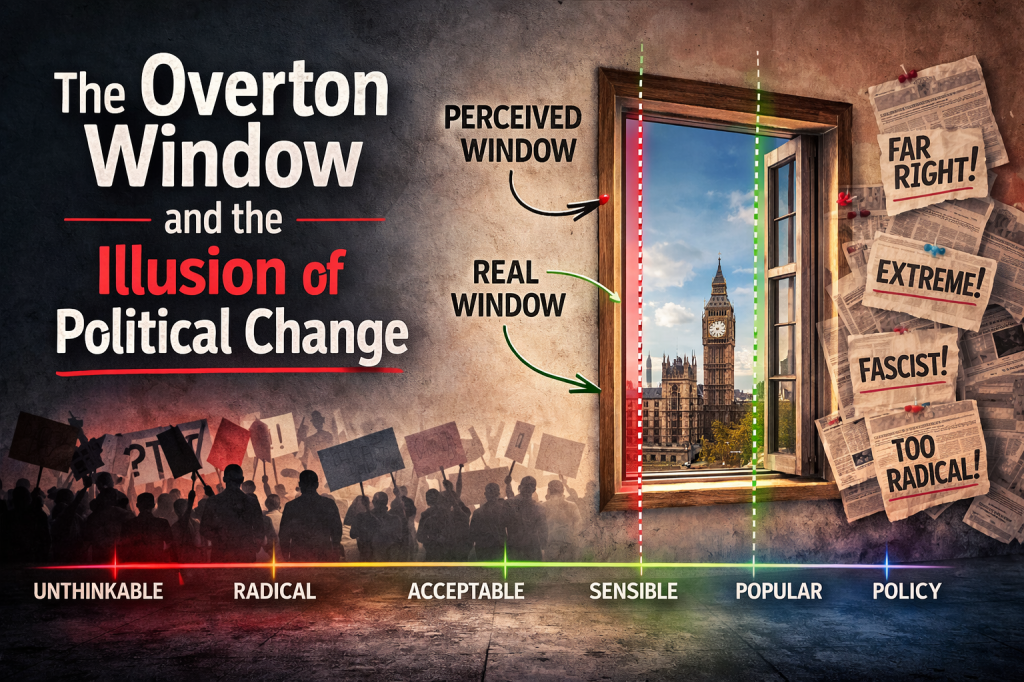
“The Overton Window is a concept that describes the range of political ideas considered acceptable in public debate at a given time.“
I’ve been seeing the phrase “The Overton Window has moved” quite a lot recently and it’s never sat quite right with me. I always felt that it didn’t reflect the nature of what the Overton Window actually was, but more what people might want it to reflect. I don’t think that has been a deliberate ploy, but just one of these ideas that gets used a lot, becomes mainstream and it’s real meaning gets diluted or lost in the rhetoric.
The Overton Window is often misunderstood as something that determines which ideas are acceptable in public debate. The reality is the opposite. The Overton Window does not create acceptability; it shows where acceptability already lies within society.
When public opinion or policy changes, the window moves. But these moves tend to be gradual. Changes in rhetoric alone do not necessarily shift it. Instead, they can change how positions inside the window are described and give the impression the window itself has moved.
The Overton Window was meant to describe where public and political acceptability sits along a spectrum of ideas. In modern debate, however, it is often used rhetorically to suggest that those boundaries themselves should move.
In practice, two different “windows” can appear in discussions like this:
The real Overton Window
The range of positions that the public and political institutions actually accept.
The perceived Overton Window
The range of positions people believe are socially acceptable to express.
These two windows are not always aligned. When they diverge, people may begin to self-censor, even though the views they hold remain within the mainstream.
What the Overton Window Actually Describes
The concept of the Overton Window was developed by Joseph P. Overton, a policy analyst at the Mackinac Center for Public Policy. His core argument was that politicians don’t lead public opinion but find themselves operating within what public opinion defines as acceptable.
The Overton Window is often illustrated as a spectrum of policy acceptability:
| Level | Description |
| Unthinkable | Too radical to be publicly discussed |
| Radical | Discussed only by fringe groups |
| Acceptable | Considered somewhat reasonable |
| Sensible | Widely seen as practical |
| Popular | Supported by most people |
| Policy | Implemented by government |
The “window” itself sits in the middle of this scale. It represents the range of ideas considered acceptable enough for politicians to openly support.
This framework can be applied to almost any policy issue. Over time, ideas can move along this spectrum. Positions that were once seen as radical may gradually become acceptable, then popular, and eventually implemented as policy.
History provides many examples of this process. American prohibition, the suffragette movement, and same-sex marriage all began outside the political mainstream before gradually moving into it as public attitudes changed.
These shifts are usually driven by changes in public opinion, changes in party platforms, and new ideas entering mainstream political debate. They tend to occur gradually, often over decades.
Rhetoric alone does not move the Overton Window.
In modern political debate, however, the concept is often invoked in a different way. It is frequently used to claim that radical policies have suddenly become acceptable, to dismiss certain arguments without engaging them, or to suggest that previously mainstream positions are now extreme.
But the Overton Window does not determine what society finds acceptable. It simply reflects it.
Repeatedly asserting that a position is radical does not move the window itself. At most, it can shift the perception of where the window lies.
And it is this gap between the real Overton Window and the perceived Overton Window that can create the illusion of dramatic political change.
To see how the gap between the real and perceived Overton Window can develop, it helps to look at examples where rhetoric, policy, and outcomes move in different directions. Before doing that, however, it is useful to understand the framework that shapes these discussions.
The Difference Between Public Opinion, Policy, Outcomes, and Rhetoric
Political debates often mix together several different layers of discussion that do not always move in the same direction.
| Layer | Meaning |
| Public Opinion | What the population broadly considers acceptable |
| Policy | Laws and official political positions |
| Outcomes | What happens in practice |
| Rhetoric | How issues are framed in political and media debate |
The Overton Window sits closest to public opinion. It reflects the range of policies that politicians believe voters will tolerate or support.
Policy usually follows that window, while outcomes depend on how policies operate in the real world. Rhetoric, meanwhile, often develops independently of the other three.
Because these layers do not always move together, it is possible for public debate to create the impression that politics has shifted dramatically even when public opinion and policy remain relatively stable.
Understanding this distinction helps explain why claims that the Overton Window has moved can sometimes reflect changes in rhetoric rather than changes in the underlying political centre.
With this framework in mind, it is worth looking at a few examples where rhetoric, policy, and outcomes appear to move in different directions.
The Overton Window does not determine what society finds acceptable — it reflects it.
Example 1. Immigration
Immigration is a useful example because it is often cited as an area where the Overton Window has supposedly shifted. It is common to see claims that the debate has moved sharply to the right and that “far-right” voices have become emboldened. However, when the issue is examined through the framework of public opinion, policy, outcomes, and rhetoric, the picture appears more complicated.
| Public Opinion | Public opinion has consistently supported the idea that countries maintain borders and control entry. This has long been a mainstream position rather than a radical one. |
| Policy | Immigration policy across most Western countries has remained broadly consistent for decades. If anything, many systems have gradually become more open over time. |
| Outcomes | Immigration levels have increased significantly over the past two decades, with illegal immigration now accounting for a noticeable share of overall net migration. |
| Rhetoric | Discussion of border enforcement or tighter immigration controls is increasingly framed in parts of the debate as “right wing” or even “far right”. |
If the Overton Window is primarily shaped by public opinion, which then influences policy, the evidence suggests that the underlying political centre has not moved dramatically. In fact, one could plausibly argue that Western societies have become more accepting of immigration over time, suggesting a modest leftward shift in outcomes and tolerance.
What has changed more noticeably is the language used in the debate.
Positions that historically sat comfortably within mainstream immigration policy, such as maintaining secure borders or enforcing immigration rules, are increasingly described as extreme. This reframing can make it appear as though the political centre has moved when the underlying policies and public attitudes remain broadly similar.
The result is a curious contradiction: the actual Overton Window moves only slightly, if at all, while the perceived window appears to shift sharply.
Political scientists sometimes refer to this dynamic as “boundary policing in discourse.” This occurs when participants in a debate attempt to influence the boundaries of acceptable discussion by redefining how certain positions are labelled.
Common techniques include:
- attaching labels such as extremist or far-right
- reframing historically mainstream policies as radical
- shifting the moral framing around a particular issue
The effect is not necessarily to change the underlying policy landscape, but to reshape how positions within that landscape are perceived.
Example 2: Government Spending
A similar disconnect can be seen in debates about government spending. Public discourse often suggests that governments are attempting to shrink the size of the state. Since the financial crisis of 2008, political rhetoric has frequently focused on austerity, efficiency, and the need for tighter control over public finances.
However, when the issue is examined through the same framework of public opinion, policy, outcomes, and rhetoric, the picture again becomes more complex.
| Public Opinion | Public opinion has generally supported a balance between fiscal responsibility and the provision of public services such as healthcare, education, and welfare. |
| Policy | Government policies have continued to fund and expand many major areas of public spending, including healthcare, education, and social support. |
| Outcomes | Over the long term, government spending has generally increased as a share of national income across many developed economies. |
| Rhetoric | The rhetoric is about austerity, balancing the budgets and more financial control. |
In other words, the rhetoric emphasises shrinking government, while the long-term outcome often shows the opposite trend.
Here again, the perception of the Overton Window can diverge from the reality. The debate may frame policy as moving strongly in one direction, while the underlying policy trajectory moves more gradually, or even in the opposite direction.
The Perception Gap
What both of these examples suggest is that it is often not the Overton Window itself that moves, but the perception that it has moved.
Media amplification, both in traditional media and on social platforms, can give disproportionate volume to particular issues or voices. When this happens, the intensity of debate can make political change appear more dramatic than it actually is.
This dynamic can lead to a phenomenon known as pluralistic ignorance, a situation that many people will recognise.
Pluralistic ignorance describes a situation where:
- Many people privately hold a view
- But they believe fewer others hold it
- Because public discourse suggests it is unpopular or unacceptable, they choose not to express it
When that happens:
- The actual Overton Window remains stable
- But the perceived Overton Window narrows
People may think the window moved even when it hasn’t.
What I am trying to highlight is how the concept of the Overton Window is often misapplied in discussions about policy and public opinion.
Two broad observations are worth keeping in mind:
- Political policy has not changed dramatically. Most Western states still operate within the same broad institutional frameworks and policy principles.
- Public opinion has not shifted dramatically either. If anything, many societies have become more socially liberal over time.
Taken together, this suggests that on many issues the Overton Window has remained broadly centrist. The range of policies considered acceptable and implemented in practice has not shifted dramatically.
What has changed is not the window itself, but the rhetoric surrounding it.
Positions that historically sat comfortably within the political mainstream are increasingly described in public debate as “far right”, “fascist”, or “far left”. The result is that while the actual policy window may remain relatively stable, the perception of where that window lies can shift significantly.
In other words, the Overton Window itself may not have moved dramatically. What has changed is the language used to describe positions inside it.
The Overton Window remains a useful concept when used carefully. But it describes where society places the boundaries of acceptable policy; it does not determine those boundaries itself.
More information on the Overton window can be found at The Overton Window – Mackinac Center – from the horse’s mouth.

 kenlaidlaw
Leave a comment