Did Brexit Cause the Rise in Small Boat Crossings? A Closer Look at the Evidence
I have noticed a trend recently where the upsurge in irregular immigration through particularly small boat crossings is being blamed on Brexit. There is a general theme where all public ills are laid at the feet of Brexit but in the case of boats crossing the English Channel it seems unlikely.
The reason for this seems to be that because the crossings started to ramp up during Brexit, that must be the cause. A simple argument, Brexit happened, numbers rose, the two must be linked.
However, this claim risks confusing correlation with causation, a classic example of the post hoc ergo propter hoc fallacy. The reality is that migration is a complex global phenomenon influenced by geopolitical instability, enforcement changes, and criminal networks. To assess whether Brexit is truly responsible, we must look at the evidence more closely.
The Dublin Regulation: What It Did and What It Didn’t Do
This regulation is one of the most cited pieces of legislation to back up the claim that the boats are the fault of Brexit. The EU’s Dublin Regulation determined which country was responsible for processing an asylum claim, typically the first EU member state a migrant entered. In practice however, it wasn’t that great at applying it.
What it did:
- Allowed participating countries to return asylum seekers to the first EU country of entry.
- Enabled the UK to transfer some applicants back to other EU states.
- Permitted the UK to accept certain cases, particularly for family reunification.
What it didn’t do:
- Prevent migrants from travelling to the UK.
- Guarantee returns; many transfers were challenged or unsuccessful.
- Apply to all migrants, only to those whose entry into another EU country could be proven.
- Stop irregular migration or dismantle smuggling networks.
- Provide the UK with participation in the Schengen Area, which it never joined.
In its later years, the UK returned relatively few individuals under the Dublin system and, in 2016 and 2017 for example, 676 were returned to the EU while 1019 were sent to the UK. All in all, the rate of returns halved between 2008 and 2017 and migration watch found that in some periods up to 50% more asylum seekers were transferred to the UK rather than from.
So, while its loss may have complicated administrative processes, it does not adequately explain the surge in Channel crossings. Given that the number of returns was relatively small, it is difficult to argue that the Dublin Regulation functioned as an effective deterrent.
The Reality of the Numbers
The number of small boat arrivals has significantly increased since 2020, although the rise in boats started around 2018. Small boat arrivals are frequently presented as definitive figures. They represent only the number of detected crossings; there is an unknowable number that are not accounted for.
This does not diminish the significance of the crossings but highlights the need for caution when interpreting statistics. The rise in recorded arrivals reflects both changing routes and improved detection.
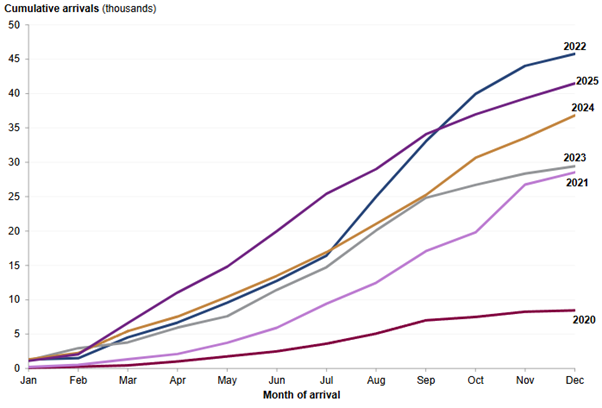
While irregular immigration has increased, it is worth noting it is only around 10% of the total net migration.
So, if Brexit is not the primary cause for the rise in small boat crossings, then what is? To answer that we need to look beyond the UK’s borders and look at the global forces that have shaped migration patterns of the last few years.
Reasons for the Growth in Small Boat Crossings Unrelated to Brexit
The reasons for the increase in small boat crossings cannot be attributed to a single source. In terms of physical routes into the UK, enhanced security at Channel ports and the Channel Tunnel reduced the entry by lorries. This has meant that alternative routes have had to be found for those wishing to cross to the UK. That adaptation has turned out to be boat crossings in a phenomenon known as “route displacement” a concept well documented in migration studies.
Never ones to miss an opportunity, criminal gangs capitalised on this shift. Encouraged by the early success of getting boats across the channel, they ramped up operations due to the increased demand. All facilitated/advertised through social media, the success of the boats getting through, most likely kept demand growth strong. A now, highly profitable enterprise for the unscrupulous that will not be easy to stop.
However, this only explains part of the problem, the mechanics of it and process for getting to the UK. It does not answer the fundamental question of where the demand growth has come from in the first place. To that we need to look at the global events that are driving the actual migration. For the top 5 nationalities coming across on boats in 2025, the table below shows by year events in their region that have influenced that rise.
Global Events Driving Migration
The rise in crossings coincides with major international crises affecting the most common nationalities arriving in the UK.
| Year | Afghanistan | Iran | Eritrea | Sudan | Somalia |
| 2018 | Ongoing Taliban insurgency. | Sanctions reimposed after U.S. withdrawal from nuclear deal. | Continued forced conscription and repression. | Political unrest before Bashir’s fall. | Persistent conflict and humanitarian crises. |
| 2019 | Continued instability. | Violent crackdown on nationwide protests. | Ongoing authoritarian rule. | Bashir overthrown; instability follows. | Severe drought and displacement. |
| 2020 | U.S. – Taliban agreement; uncertainty rises. | Economic hardship worsens amid COVID-19. | Continued repression. | Fragile transitional government. | Pandemic exacerbates food insecurity. |
| 2021 | Taliban seize power after Western withdrawal. | Ongoing repression and economic decline. | Continued emigration. | Military coup destabilises transition. | Insurgency and humanitarian challenges persist. |
| 2022 | Humanitarian crisis deepens. | Mahsa Amini protests and crackdown. | No meaningful reform. | Political instability continues. | Worst drought in decades. |
| 2023 | Economic collapse persists. | Continued unrest. | Continued repression. | Civil war erupts between SAF and RSF. | Flooding and ongoing insecurity. |
| 2024 | Ongoing humanitarian crisis. | Economic and political pressures persist. | Continued outward migration. | War continues, creating mass displacement. | Continued instability and climate pressures. |
The events in this table are factors that push people to flee their homeland and while there have been some Western interventions in some of those areas, they are not the significant factors in most cases. Afghanistan is probably the most likely to have been in a large part caused by UK and allied direct interference, but even then, the impact from the sharp US exit will certainly have exacerbated the problem.
In contrast, migration from countries such as Eritrea, Iran, Sudan, and Somalia is overwhelmingly driven by domestic repression, civil conflict, economic hardship, and humanitarian crises.
Taken together, these global forces provide a far more compelling explanation for the rise in small boat crossings than Brexit alone.
The claim that Brexit caused the rise in small boat crossings oversimplifies a complex issue.
- The Dublin Regulation had limited effectiveness and was not a decisive deterrent.
- Recorded arrival figures reflect detected crossings, not the entirety of irregular migration.
- Improved security and route displacement shifted migration toward small boats.
- Smuggling networks adapted rapidly to changing conditions.
- Global instability, including conflict, repression, and humanitarian crises drove migration from key source countries.
Brexit altered administrative arrangements, but it did not create the conditions that compelled people to flee or enabled the Channel route to emerge.
Brexit is not the cause of all the UK’s problems, despite how often our politicians would have us believe otherwise. In the long list of challenges facing the country, most predate Brexit, and within that list Brexit is barely a footnote. It is certainly not the primary driver behind the rise in small boat crossings. Until we are honest about these realities, Brexit will remain a convenient excuse for governments unwilling, or unable to address the underlying issues.
Useful links for further information:
Dublin agreement on returning asylum seekers is almost completely useless | Migration Watch UK
How many people come to the UK via irregular entry routes? – GOV.UK


 kenlaidlaw
Leave a comment