With the recent election of Andy Burnham, I have seen increasing discussion about replacing council tax with a single property tax based on the current value of a home, rather than the band it has been allocated. Much of that discussion is framed around fairness, with comparisons between high-value homes in London and lower-value homes elsewhere.
This blog aims to explain what council tax is, why it was designed the way it is, and why I believe much of the current debate misunderstands its purpose.
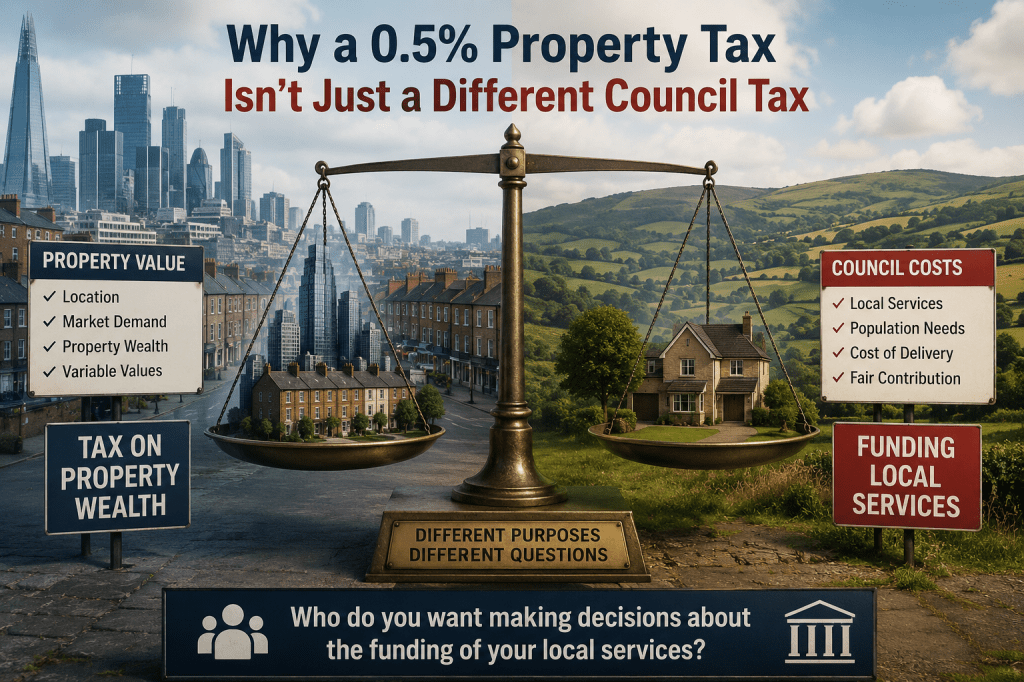
Council tax isn’t trying to answer the question, “How much is your house worth?” It’s trying to answer the question, “What is your fair contribution towards the cost of running your local council?” Those are very different questions.
The examples used in support of a property tax are rarely about local government finance. They are almost always comparisons between expensive homes in the Southeast and cheaper homes elsewhere. That suggests the debate has shifted from funding local services to redistributing housing wealth.
If the aim is to introduce an annual tax on housing wealth, then that should be debated openly on its own merits. If the aim is to fund local government fairly and efficiently, then we should judge any replacement by how well it achieves that objective.
Before we decide whether to replace it, we should first understand what it is actually designed to do.
So What council tax is actually for?
This sounds obvious but judging by many of the proposals currently being discussed, it clearly isn’t.
The purpose of council tax is to help fund local services, plugging the gap between the funding provided by central government and the cost of running the local area.
It isn’t designed to be a wealth tax. Instead, it is designed to apportion the cost of local services across households using a progressive banding system. Those bands were based on the relative value of properties in 1991 (or, for newer properties, what they would have been worth at 1991 prices).
Within a local authority, what really matters is the distribution of housing, not the absolute value of each individual property. If an area consists of:
- 10% Band A
- 25% Band B
- 40% Band C
- 20% Band D
- 5% Bands E–H
then those proportions determine how the council tax burden is shared between households.
Whether every house doubles in value over the next twenty years doesn’t fundamentally change that distribution. The houses may all be worth more, but their relationship to one another remains broadly the same.
In other words, council tax is concerned with the relative position of properties within a local area, not market value across the whole country.
their relationship to one another remains broadly the same.
The real unfairness in the council tax system is that two very similar houses, one valued in 1991 and one built and valued in 2025 at what it would have cost in 1991 can be in very different bands. This is a genuine problem with the system that does need resolved, probably by a broad revaluation across whole council areas.
People also argue that the bands are relatively coarse and that distinctions between bands could create more bands broadening the spread of costs and increasing the progressive nature of them. So, is the system perfect, no, far from it. Can it be fixed, probably, but it brings us back to what the question is, are we discussing local funding or wealth redistribution?
What a flat property tax would change
What is being proposed with a flat tax across properties is where my concerns start to arise. It is moving the question away from, how do we fund local councils to how do we tax property wealth. These are not the same things, shift the objective of the tax and potentially leave councils in areas with poor housing values strapped for cash. It is fundamentally a different form of taxation replacing a system it doesn’t relate too.
Where I see the problems: –
- Centralisation of local government finance
This for me is a big problem, it changes the balance of power moving it away from councils to a centralised government. If the councils need more funding one year, they will have to go cap in hand to the government who also have to balance any request against every other area.
it changes the balance of power moving it away from councils to a centralised government
Currently, if Council A wants to spend more than Council B, Council A can (within the existing rules) justify a higher council tax to its own electorate. This will remove that as an option from local councils.
A flat tax rate would also mean areas where house prices are high would end up funding areas where house prices were lower. A council area with low property values may be unable to raise enough funds to support itself. There is no necessary relationship between property values and the cost of running a council.
Areas with higher population densities are affected in different ways. London council tax appears cheap not because they aren’t paying their share but because they are stacked on top of each other.
- Who values every property?
Who values every property, how many valuations and how often do they occur, will prices just be assumed to have risen by the national average each year to increase funding? Who pays for the valuations, councils or central government?
- Property values are subjective
Unlike income, there isn’t a single correct value and a property at the end of the day is only worth what someone will pay for it.
Two valuers can legitimately disagree on the value of the same property by tens of thousands of pounds, and under a property tax that difference has an annual tax consequence.
Are we going to see properties fall into a state of disrepair just to keep values down, unkept gardens and flaking paintwork? I dislike gardening so there are some plus sides.
Because of the subjective nature I can see a lot of disputes and appeals taking shape across the country.
- The tax rate becomes politically easy to change
Once this is in place, what is to stop the government changing the rate, or using the taxation as general taxation to be spent outside local councils? Yes local councils also increase the council tax each year, but for the needs of your council and ultimately you can vote them in our out locally. A national property tax creates one very easy lever for central government to pull.
Accountability becomes blurred with national and local councils each blaming each other.
At what level do funds need to be raised, how do you set the correct rate of tax to cover all funding needs, does the proposed 0.5% raise the same amount of money as the current council tax does? You can’t really know that until you have revalued the whole country and then what if it doesn’t?
- Location rather than consumption
It targets higher value properties in locations rather than by consumption of services. A modest London terraced house can be worth multiples of a large detached house elsewhere. The reflects the property demands of the area, not the incomes and liquidity of the people living in them. A nurse in a high value area still needs a house to live in but potentially due to higher housing costs has less disposable income than the same nurse in a lower value property area. They both need a house…
- Cash-flow versus wealth
There are a lot of very ordinary people sitting in expensive houses, with very little liquidity or income. Asset rich but income poor households could face significant tax bills every year that they simply can not afford.
- It changes the purpose of the tax
Council tax is to fund local government, where as a tax on the value of housing is a tax on housing wealth, these are different things with different policy objectives. If that’s what they want to do then it is a perfectly reasonable policy choice, but it isn’t an effective replacement for council tax.
The irony of the debate
The proposal is often sold as making “the rich pay their fair share.” In practice, much of the extra revenue would come from ordinary households in areas with inflated property values, particularly London and the Southeast. If that revenue is gathered centrally and redistributed, as it almost certainly would have to be, the debate is no longer about council tax at all. It’s about using property wealth in one part of the country to fund services in another.
If we want an annual tax on housing wealth, let’s debate that honestly. If we want to reform how local government is funded, let’s debate that too. But treating those two ideas as if they are the same thing risks creating a system that is neither a good local tax nor a particularly coherent wealth tax.
The question fundamentally boils down to, who do you want making decisions about the funding of your local services.





Leave a comment